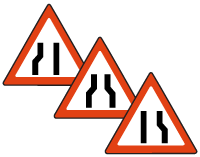
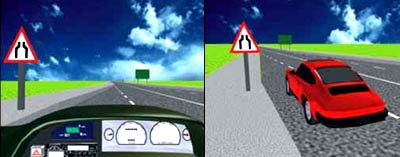
ROAD NARROWS
Where:
On any public roadway, typically where the width of the road ahead decreases due to a change in road design, construction work, a bridge, or natural obstacles such as rock faces or embankments.
The sign may indicate that the road narrows from both sides or only from one side (left or right), depending on the layout of the road.
It is commonly found on rural roads, mountain passes, or older routes that transition into narrower sections.
Purpose:
To warn drivers that the road ahead will become narrower, reducing the available space for vehicles travelling in either direction.
This may make it more difficult for two vehicles to pass each other safely, especially large or wide vehicles.
The sign helps alert drivers to prepare for tighter conditions, slower speeds, and the possibility of oncoming traffic encroaching closer to their lane
Action:
Reduce speed well before reaching the narrow section to allow time to react safely.
Adjust your position on the road to stay within your lane and avoid crossing the center line.
Be alert for oncoming traffic, as the reduced width means vehicles will pass closer together.
Yield or give way where necessary, particularly if the narrowing occurs on your side of the road or if the section is too narrow for two vehicles to pass simultaneously.
Avoid overtaking in or near the narrowed section, as visibility and space are limited.
Be cautious of pedestrians, cyclists, or road workers who may be using the narrow portion of the road.
Drive at a speed that allows you to stop within the distance you can see, especially when approaching blind or curved sections.